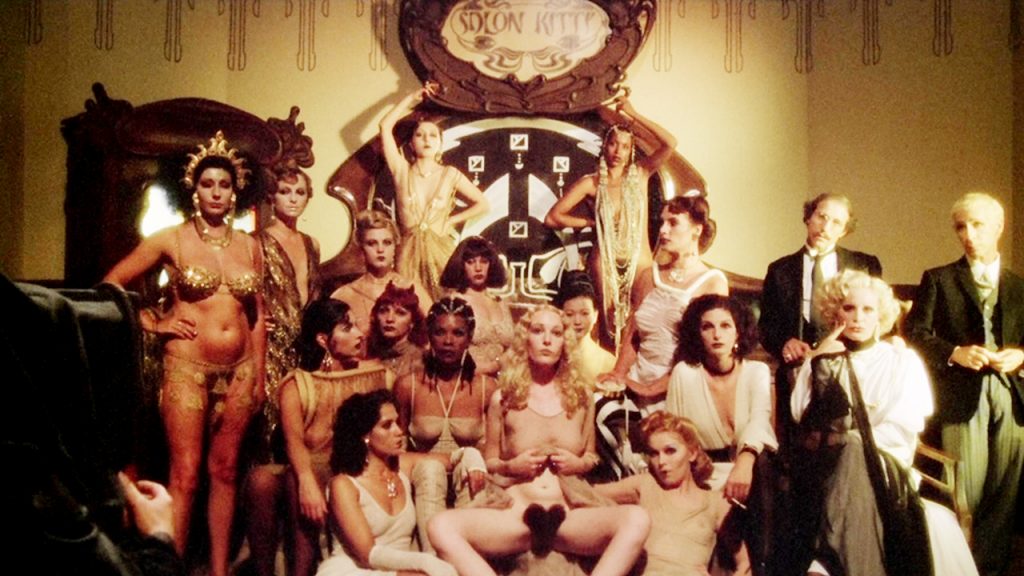
“Salon Kitty” (Tinto Brass, It/Fr/Ger, 1976)
Liliana Cavani’s “The Night Porter” (1974) set more things in motion than mere dismay and upset reviews. Her film also brought other films on the same hot topic. Italian softcore maestro Tinto Brass jumped on this “Nazisploitation” bandwagon and graduated with honors; with his “Salon Kitty” (1976) he carved out a place in film history (more so than with his following epic, “Caligula,” (1979)) that’s irrevocable – also not unlike Cavani.
Ingrid Thulin portrays Madame Kitty – in charge of her own brothel, and carrying on in a carefree Weimar spirit. This changes when SS officer Wallenberg (exquisitely portrayed by Helmut Berger) tells her to move her business to new premises – a property prepared with microphones in each room. With a stable of new girls, chosen for their devotion to National Socialism and thoroughly examined by Wallenberg and the SS, Kitty has her hands full again.
Thulin is absolutely wonderful as the hysteric Madame. For her, it’s all song & dance, champagne and outrageous outfits, while her girls pleasure soldiers, officers and other potentati. Each girl secretly reports on each customer, and the devious SS staff can compare the reports with their own recordings (that the girls, as well as Kitty, are unaware of).
Hence, a simple story of betrayal and perversion, set in a time and space usually displayed via filmic filters of war and martial atrocities. But in Brass’s epic the venusian perspective rules supreme: flaunting not only an orgy of sexual activities and flamboyant cabaret acts (how did Thulin rate these, post-facto?) but also a keen aesthetic sense. Brass’s film revels in art deco, uniforms, and sensual yet soulless bodies in the obedient service of the Third Reich. The perspective is in itself a perverted look at something usually regarded basically as sacrosanct and confined exclusively to the sphere of suffering.
What Cavani opened up with her sexualizing – some would argue “fetishizing – of SS/victim relationships, Brass bends open further with typical Italian insensitivity and tasteful tastelessness. It’s “The Night Porter” mixed with “Cabaret” through a storyline that seems to exist merely as evanescent glue in-between tableaux of debauchery and erotic excess. The film feels rooted in its 1970s Europe as much as in a 1930s ditto – as much some kind of risqué fashion shoot by Helmut Newton as a shocking, pseudo-moralistic tale of good vs evil. “Salon Kitty” simply assaults the senses in a colourful and sordid mix of high & low.
Brass successfully got away with it; in part thanks to the elegant lavishness of the surface, but perhaps more so thanks to the brilliant casting of Thulin and Berger (who, of course, had bonded already in Visconti’s “The Damned” in 1969 – which also starred both Dirk Bogarde and Charlotte Rampling, who undoubtedly became the “it” girl of Nazi bdsm fantasies in Cavani’s masterpiece). They’re both cartoonish, but stylishly so – caught forever in grand style Eurosleaze exploitation cinema but with no reason for regrets at all.